Recording Your Parents' Voices
While You Still Can
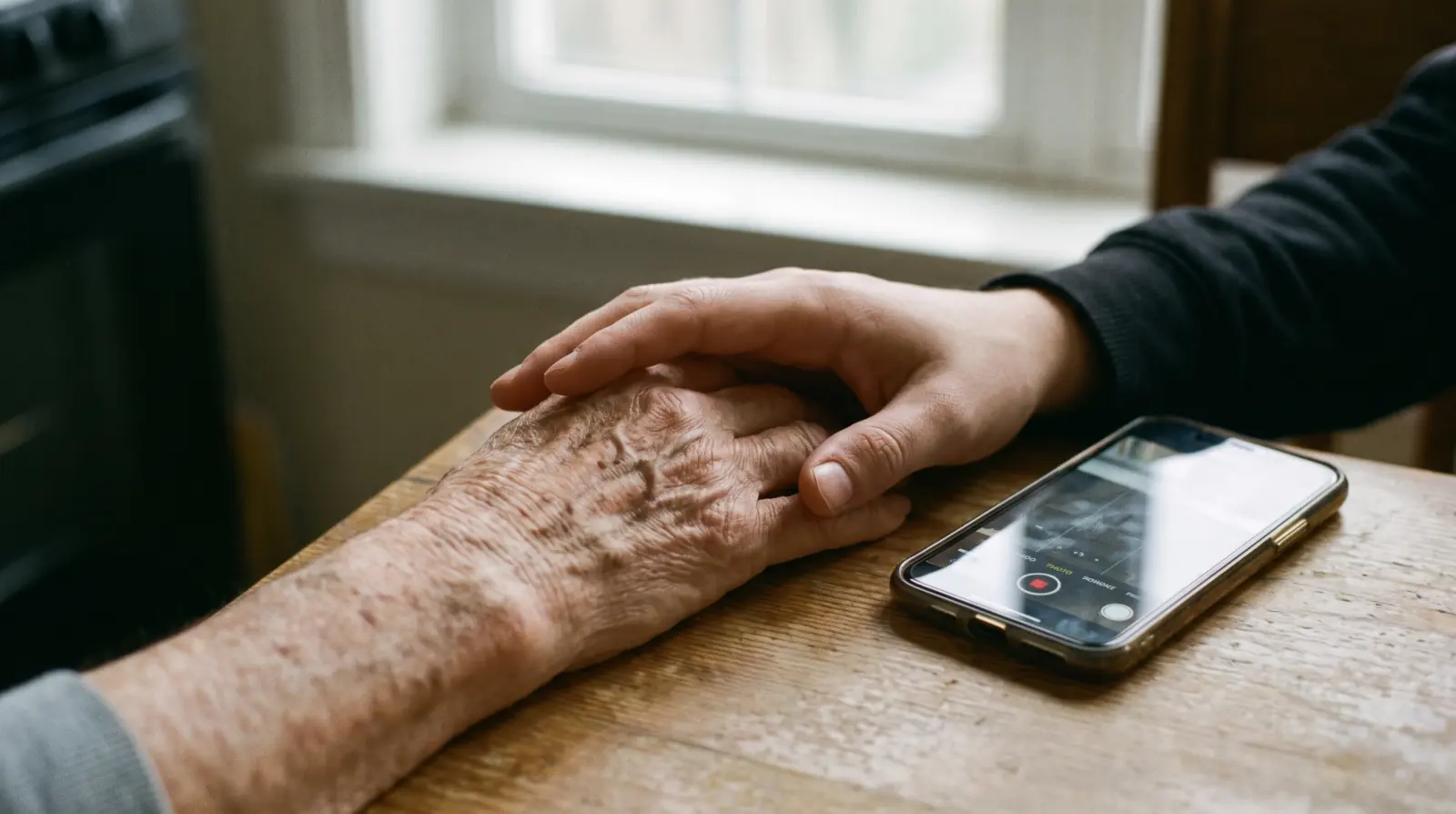
Why record a parent's voice now?
Because recordings are the raw material of memory, and memory on its own does not hold a voice. Faces stay in photographs. Voices survive only where somebody happened to press record. In our experience, the first thing a family looks for after a loss is a voicemail nobody deleted, and what they find is whatever chance left behind: a message about a dentist appointment, a few words half-covered by restaurant noise. Ten minutes recorded on purpose now, while your parent is well and unhurried, is worth more than every salvaged fragment put together. It is also easier now than it will ever be. You can ask a real question, let them answer at length, and record it again next week if the first attempt comes out stiff. None of this requires a diagnosis or an anniversary. It only requires doing it before there is a reason to.
The practical case is simple. A parent in ordinary health speaks in their ordinary register: full sentences, laughter, the small verbal habits that make a voice recognisable. That is the version of them a family later wants to hear, and it is the version that stops existing first. Illness changes a voice long before it ends one.
There is a second reason, less obvious and probably more valuable. People answer questions they are asked. Most parents will never volunteer the story of how they chose a career, or what they were frightened of at thirty, because nobody sat down and asked. A recording is a reason to ask.
What should you ask them?
Ask about specific things, not about their life. "Tell me about your childhood" produces a summary paragraph. "What did the kitchen smell like in the house you grew up in?" produces ten minutes. Concrete questions give a person something to see while they talk, and a person describing something they can see stops performing and starts remembering. Keep the list short, ask one question at a time, and stay quiet after the answer instead of jumping to the next question. The pause is usually where the good material arrives. Nine questions below are the ones our studio returns to most often. You do not need all of them; four answered properly is a real recording, and it is fine to leave the rest for another day.
- Describe the home you grew up in. What room were you in most, and who else was in it?
- How did you and Mum/Dad meet? What did you think of them at first?
- What were you doing at twenty-five, and what advice would you give that person now?
- Tell me the story you always tell. The one we can all recite. Tell it properly this time.
- What is something you were proud of that nobody made a fuss about?
- What did your own parents do that you decided to do differently?
- What did you worry about that turned out not to matter?
- What do you want your grandchildren, or the grandchildren you haven't met, to know about you?
- Is there anything you have never said out loud that you would like recorded?
Two notes on the last question. Ask it near the end, when they are warmed up, and accept "no" without pushing. And tell your parent beforehand what you are doing and where the recording will be kept. A recording made with someone's knowledge and consent is a different object from one made quietly, and the difference matters later.
How do you record it well at home?
The voice memo app already on your phone is enough. Sit in a room with soft furniture, curtains or a rug, and switch off the television, the extractor fan and any air conditioning. Put the phone on a table roughly 30 cm from your parent, screen up, and do not hold it. The default recording quality on a modern phone, usually 44.1 kHz, is well beyond what a voice needs. Record several short sessions rather than one long one: twenty minutes is where most people tire and start giving shorter answers. When you finish, save two copies in two places, for example the phone plus a cloud drive or a computer. A single file on a single phone is not preserved, it is stored, and phones are lost. If you can also record video, do, but audio is the part that carries.
- Room: soft surfaces absorb echo. A living room or bedroom beats a kitchen or hallway.
- Distance: about 30 cm, off to one side of the mouth rather than directly in front of it, which reduces popped consonants.
- Interruptions: phones on silent, not vibrate. A vibrating phone on a wooden table is louder on a recording than in the room.
- Your own voice: ask the question, then stop talking. Do not murmur agreement while they speak, because it lands on top of their words.
- Naming: save files as name-topic-date. In five years you will not remember what "New Recording 43" contains.
- Backups: two copies, two locations, checked once a year.
If a first attempt feels awkward, that is normal and it is not wasted. The second session is almost always better, because both of you have stopped noticing the phone.
What is a Legacy Voice Session?
It is our guided version of everything above, from US$1,290. A Legacy Voice Session is a remote video interview of 60 to 90 minutes. We send our question guide in advance, run the conversation so that your parent is talking to an interviewer rather than to a camera, and record it properly at both ends. We then edit the material into a legacy film of 8 to 12 minutes, delivered typically within seven days of the recording. Voice-asset preservation, meaning a clean archived copy of the isolated speech, is an option you can add. We should be honest about what you are paying for: we guide and we edit. There is no technology in this service. The value is that the right questions get asked, the silences get held, and somebody else takes on the work of turning two hours of conversation into something a family will actually sit and watch.
Most people do not need us for this. A phone and an afternoon produce a recording that will matter enormously to your family, and we would rather you do that today than plan a session you never book. Where a guided session earns its price is narrower: when the relationship makes it hard for you to ask directly, when a parent performs for their own child but relaxes with a stranger, when the family is spread across countries, or when nobody has the time to edit two hours of footage into something watchable. As far as we know, few videography studios offer a guided legacy interview at a published price, which is part of why we publish ours.
| Route | Cost | What you end up with |
|---|---|---|
| Record it yourself | Nothing | Raw audio or video you keep, back up and edit yourself |
| Legacy Voice Session | From US$1,290 | Guided 60–90 minute interview, edited 8–12 minute legacy film, typically within seven days, optional voice-asset preservation |
| Voice Farewell, after a loss | From US$649 | A 2–3 minute memorial film in which the recreated voice reads a farewell letter, made from whatever recordings exist |
Do you need this before someone passes for a voice farewell later?
No. Roughly 60 seconds of clear speech is enough for a Voice Farewell later, and most families already have that somewhere. A deliberate recording made now is simply much better raw material than a salvaged voicemail: no compression from a phone network, no television in the background, no thirty-year-old camcorder tape. Better source audio means a closer result and fewer projects that fail the preview test. But recording your parent now is worth doing whether or not anyone ever asks us for a farewell film, and we would say the same if we sold nothing. The recording is the point. What our studio makes afterwards is one bounded farewell, a voice reading words the family chose, and then it ends. It is not digital immortality, not a chatbot, and not a version of your parent that keeps talking.
So treat the two decisions as separate. Recording your parents is preservation, and it is the part with a deadline nobody announces. A memorial film is something a family may or may not want years later, and that choice can wait until there is a reason to make it. The full boundaries we work inside are set out in our Consent & Ethics policy, including the rule that a person's own stated wishes come first.
If your parent is unwell now and you are deciding what to do this week, record short sessions and record them soon. Clear speech in a quiet room, even a few minutes of it, is worth more than a longer conversation you keep postponing until they feel better.
Thinking about a guided session, or unsure whether the recordings you already have are worth keeping? Tell us what you have and who you would be recording. We reply within one business day with an honest answer, including when the honest answer is that you do not need us and should just use your phone this weekend.
Start an inquiry