Consent & Ethics:
our rules for recreating a voice
AI can now recreate a person's voice from a few recordings. That fact doesn't tell you whether it should. This page is our plain-language answer — the rules we work by, and the projects we refuse.
Can AI recreate a deceased person's voice?
Yes. With roughly 60 seconds of usable recordings — home videos, voicemails, voice messages — current voice-cloning models can recreate a recognizable version of a person's voice reading new words. Quality depends on the recordings: clean audio produces a close likeness, while short or noisy clips may not. That is why Voice Legacy produces a 15-second preview first, and the family — not us — decides whether it truly sounds like them. If it doesn't, the project ends and you don't pay.
Is it ethical to clone a deceased person's voice?
Only under conditions — and consent is the first one. Public-attitude research on "digital resurrection" consistently finds that acceptance depends almost entirely on whether the person consented, or would plausibly have consented, while alive. Researchers at the University of Cambridge's Leverhulme Centre for the Future of Intelligence warned in 2024 that AI recreations of the dead can cause real psychological harm without consent protocols and design safeguards — including what they call unwanted "digital hauntings."
Source: University of Cambridge, Leverhulme Centre for the Future of Intelligence, "Call for safeguards to prevent unwanted 'hauntings' by AI chatbots of dead loved ones" (2024). Voice Legacy consent policy, 2026.
Who must give consent?
The person first, the family second. Before any project, we ask two questions. Did the person ever say they wouldn't want this? If yes — even informally — we refuse the project, regardless of what the family wants. Second, does the close family agree? We require the commissioning family member to confirm consent on behalf of the immediate family, and if any close family member objects at any point — before, during, or after production — we stop, and we delete. Grief is hard enough without a family argument over a video.
What we refuse to build
- No chatbots of the dead. We make one farewell film — not an avatar you keep talking to. A goodbye should be allowed to end.
- No "digital immortality." We don't sell the idea that anyone can be kept alive in software, and we believe selling that to a grieving family is wrong.
- No commercial, political, or public use. Every film is licensed for the memorial service and private family keeping only.
- No projects against the person's known wishes — and no public figures, ever, without documented authorization from their estate.
What happens to the recordings and the voice model?
They are deleted. Voice processing runs on local machines in our studio and is never uploaded to third-party services for model training. Within 30 days of delivery, the source recordings and the voice model are destroyed, and we confirm the deletion to you in writing — unless the family explicitly asks us to archive them. Any family member can request earlier deletion at any time, no reason needed.
About the pictures on this site
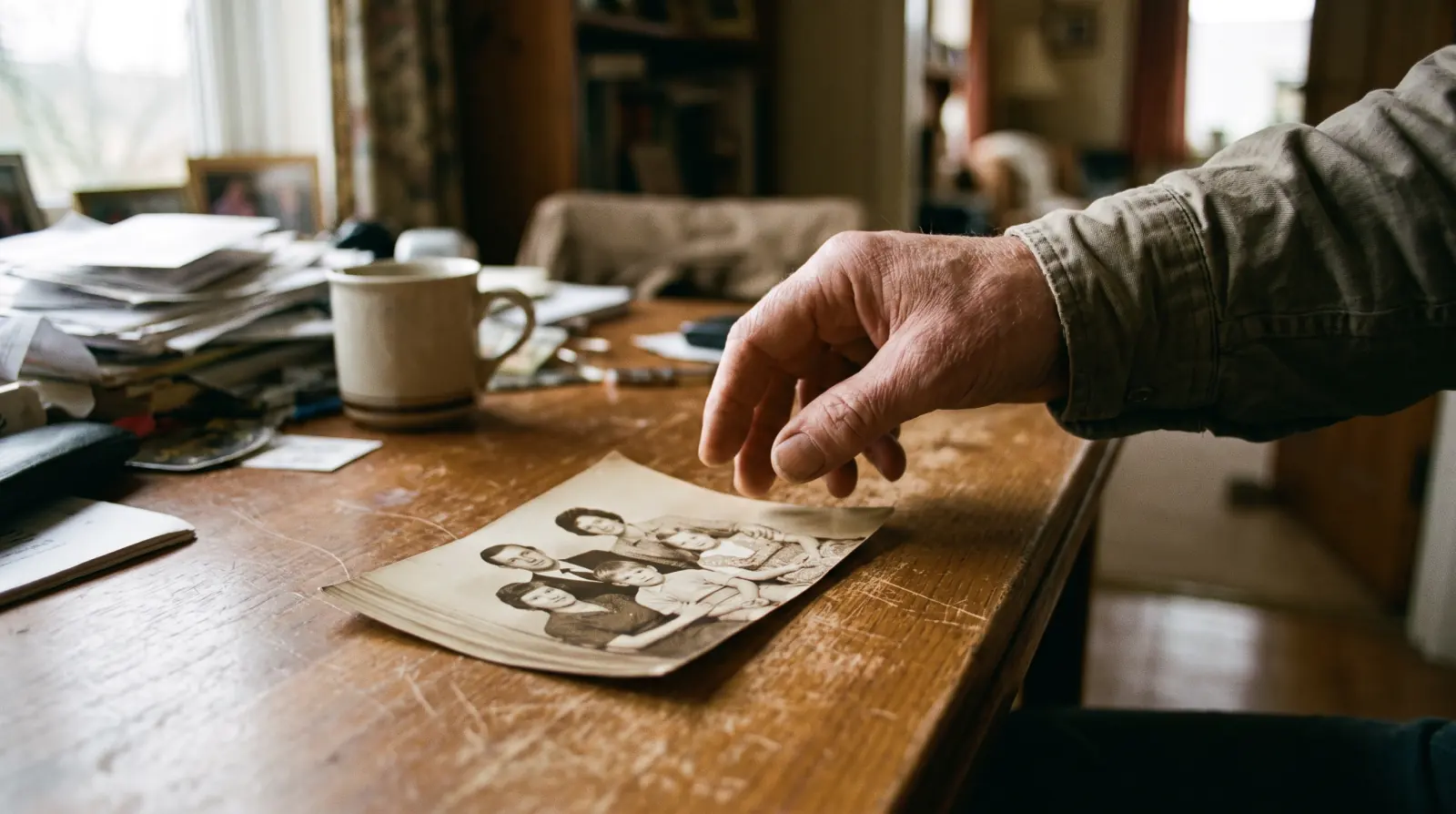
They are AI-generated still lifes. Every one of them shows objects — a table, an envelope, a cassette, an empty chair. None of them shows a person, and none of them shows a real family's belongings. We say so here because a studio that asks families to trust it about AI should not be quietly using AI pictures of strangers to sell the idea.
Is this legal in the United States?
The law varies by state, so we don't rely on the law — we rely on consent. Posthumous rights to a person's voice and likeness differ dramatically across US states: some protect them for decades, others barely at all, and digital-replica laws are actively evolving. Voice Legacy treats family authorization and the person's own wishes as the operative safeguard in every project, everywhere. Every film is labeled as containing AI-generated content.